
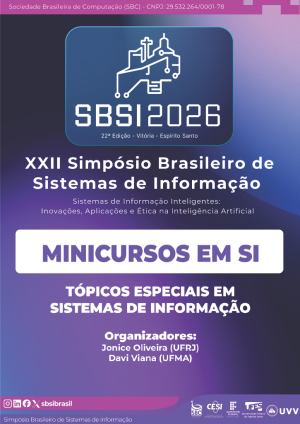
Tópicos Especiais em Sistemas de Informação: Minicursos SBSI 2026
Palavras-chave:
Sistemas de Informação, Inteligência Artificial, Abordagens PráticasSinopse
O Livro de Minicursos do SBSI 2026 aborda conteúdos relacionados à inteligência artificial (IA), design especulativo e pesquisa em sistemas de informação (SI). No primeiro capítulo, intitulado “Sistemas de Informação Além do Sociotécnico: Explorando o Entrelaçamento entre IA e Humanos com Design Especulativo”, os autores apresentam uma crítica à visão sociotécnica tradicional dos SI e propõem, com base no ciborgue de Haraway, no Design Especulativo e na abordagem Speculative Entangled Design, uma compreensão relacional e eticamente situada da integração entre humanos, tecnologias e IA. No segundo capítulo, “Ferramentas de Inteligência Artificial Para Suporte ao Processo de Pesquisa em Sistemas de Informação”, os autores apresentam, de forma prática, como integrar LLMs e ferramentas de IA ao ciclo de vida da pesquisa científica de maneira produtiva, ética e transparente. Os dois minicursos apresentam abordagens práticas e atuais sobre o uso crítico de tecnologias emergentes na área de SI, constituindo materiais úteis especialmente para quem deseja iniciar ou aprofundar sua atuação nos temas abordados.
Capítulos
-
1. Sistemas de Informação Além do Sociotécnico: Explorando o Entrelaçamento entre IA e Humanos com Design Especulativo
-
2. Ferramentas de Inteligência Artificial Para Suporte ao Processo de Pesquisa em Sistemas de Informação
Downloads
Referências
Annepaka, Y. and Pakray, P. (2025). Large language models: a survey of their development, capabilities, and applications. Knowledge and Information Systems, 67(3):2967–3022.
Bahdanau, D., Cho, K., and Bengio, Y. (2014). Neural machine translation by jointly learning to align and translate. arXiv preprint arXiv:1409.0473.
Bardzell, J. and Bardzell, S. (2013). What is"critical"about critical design? In Proceedings of the SIGCHI conference on human factors in computing systems, pages 3297–3306.
Brown, T., Mann, B., Ryder, N., Subbiah, M., Kaplan, J. D., Dhariwal, P., Neelakantan, A., Shyam, P., Sastry, G., Askell, A., et al. (2020). Language models are few-shot learners. Advances in neural information processing systems, 33:1877–1901.
Candy, S. and Dunagan, J. (2017). Designing an experiential scenario: The people who vanished. Futures, 86:136–153.
Chamaidi, T. and Stavrakis, M. (2024). A multispecies interaction design approach: Introducing the beings activities context technologies (bact) framework. Multimodal Technologies and Interaction, 8(9):77.
Chen, Q., Yang, M., Qin, L., Liu, J., Yan, Z., Guan, J., Peng, D., Ji, Y., Li, H., Hu, M., Zhang, Y., Liang, Y., Zhou, Y., Wang, J., Chen, Z., and Che, W. (2025). Ai4research: A survey of artificial intelligence for scientific research.
Chisita, C. T., Durodolu, O. O., and Rusero, A. M. (2025). Data capitalism in the milieu of the surveillance economy: What can libraries do? IFLA Journal, 51(2):339–349.
da Silva Paulichi, J. (2025). The digital persona and surveillance capitalism: contemporary challenges to the protection of personality rights in cyberspace1. Pensar, 30:1–20.
DeepMind, G. (2025). Gemini 3 pro. [link]. Multimodal Large Language Model.
Deng, Z., Ma, W., Han, Q.-L., Zhou, W., Zhu, X., Wen, S., and Xiang, Y. (2025). Exploring deepseek: A survey on advances, applications, challenges and future directions. IEEE/CAA Journal of Automatica Sinica, 12(5):872–893.
Devlin, J., Chang, M.-W., Lee, K., and Toutanova, K. (2019). BERT: Pre-training of deep bidirectional transformers for language understanding. In Burstein, J., Doran, C., and Solorio, T., editors, Proceedings of the 2019 Conference of the North American Chapter of the Association for Computational Linguistics: Human Language Technologies, Volume 1 (Long and Short Papers), pages 4171–4186, Minneapolis, Minnesota. Association for Computational Linguistics.
Dunne, A. and Raby, F. (2024). Speculative Everything, With a new preface by the authors: Design, Fiction, and Social Dreaming. MIT press.
Fitzgerald, A. (2025). Death by data: Abstraction and the political economy of computationally driven state violence. Media Theory, 9(1):169–200.
Forlano, L. E. and Halpern, M. K. (2023). Speculative histories, just futures: From counterfactual artifacts to counterfactual actions. ACM Transactions on Computer-Human Interaction, 30(2):1–37.
Frauenberger, C. (2019). Entanglement hci the next wave? ACM Transactions on Computer-Human Interaction (TOCHI), 27(1):1–27.
Giaccardi, E., Redström, J., and Nicenboim, I. (2025). The making (s) of more-than human design: introduction to the special issue on more-than-human design and hci. Human–Computer Interaction, 40(1-4):1–16.
Gottweis, J., Weng, W.-H., Daryin, A., Tu, T., Palepu, A., Sirkovic, P., Myaskovsky, A., Weissenberger, F., Rong, K., Tanno, R., et al. (2025a). Towards an ai co-scientist. arXiv preprint arXiv:2502.18864.
Gottweis, J., Weng, W.-H., Daryin, A., Tu, T., Palepu, A., Sirkovic, P., Myaskovsky, A., Weissenberger, F., Rong, K., Tanno, R., Saab, K., Popovici, D., Blum, J., Zhang, F., Chou, K., Hassidim, A., Gokturk, B., Vahdat, A., Kohli, P., Matias, Y., Carroll, A., Kulkarni, K., Tomasev, N., Guan, Y., Dhillon, V., Vaishnav, E. D., Lee, B., Costa, T. R. D., Penadés, J. R., Peltz, G., Xu, Y., Pawlosky, A., Karthikesalingam, A., and Natarajan, V. (2025b). Towards an ai co-scientist.
Haraway, D. (2013). A cyborg manifesto: Science, technology, and socialist-feminism in the late twentieth century. In The transgender studies reader, pages 103–118. Routledge.
Harman, G. (2018). Object-oriented ontology: A new theory of everything. Penguin UK.
Hines, A., Bishop, P. J., and Slaughter, R. A. (2006). Thinking about the future: Guidelines for strategic foresight. Social Technologies Washington, DC.
Jones, K. S. (1994). Natural language processing: a historical review. Current issues in computational linguistics: in honour of Don Walker, pages 3–16.
Joseph, S. R., Hlomani, H., Letsholo, K., Kaniwa, F., and Sedimo, K. (2016). Natural language processing: A review. International Journal of Research in Engineering and Applied Sciences, 6(3):207–210.
Latour, B. (2005). Reassembling the social: An introduction to actor-network-theory. Oxford university press.
Latour, B. (2012). We have never been modern. Harvard university press.
Liddy, E. D. (2001). Natural language processing. In Encyclopedia of Library and Information Science. Marcel Dekker, Inc., New York, 2nd edition.
Lin, L., Wang, L., Guo, J., and Wong, K.-F. (2025). Investigating bias in llm-based bias detection: Disparities between llms and human perception. In Proceedings of the 31st International Conference on Computational Linguistics, pages 10634–10649.
Loutfi, M. S. (2025). Entanglement Theories and Speculative Design in the Co-Constitution of Sociotechnical Realities. Tese de doutorado, Universidade Federal do Estado do Rio de Janeiro, Rio de Janeiro, RJ, Brasil.
Luo, H. and Shi, D. (2025). Algorithmic embodiment and the posthuman condition: Reframing human autonomy in n. katherine hayles’ media culture theory. Convergence, page 13548565251403045.
Lupton, D. (2015). Donna haraway: The digital cyborg assemblage and the new digital health technologies. In The Palgrave handbook of social theory in health, illness and medicine, pages 567–581. Springer.
Maleki, N., Padmanabhan, B., and Dutta, K. (2024). Ai hallucinations: a misnomer worth clarifying. In 2024 IEEE conference on artificial intelligence (CAI), pages 133–138. IEEE.
Malpass, M. (2019). Critical design in context: History, theory, and practice. Bloomsbury Publishing.
Mienye, I. D., Swart, T. G., and Obaido, G. (2024). Recurrent neural networks: A comprehensive review of architectures, variants, and applications. Information, 15(9):517.
Milojević, I. and Inayatullah, S. (2015). Narrative foresight. Futures, 73:151–162.
Mishra, T., Sutanto, E., Rossanti, R., Pant, N., Ashraf, A., Raut, A., Uwabareze, G., Oluwatomiwa, A., and Zeeshan, B. (2024). Use of large language models as artificial intelligence tools in academic research and publishing among global clinical researchers. Scientific reports, 14.
Mitrović, I., Auger, J., Hanna, J., and Helgason, I. (2021). Beyond speculative design: past–present–future. SpeculativeEdu; Arts Academy, University of Split.
OpenAI (2025). Gpt-5. [link]. Large Language Model.
Østbø, J. (2021). Hybrid surveillance capitalism: Sber’s model for russia’s modernization. Post-Soviet Affairs, 37(5):435–452.
Pasa, B. and Sinni, G. (2024). Democracy in outer space: Speculative design for future citizenship. In For Nature/With Nature: New Sustainable Design Scenarios, pages 965–980. Springer.
Peters, M. E., Neumann, M., Iyyer, M., Gardner, M., Clark, C., Lee, K., and Zettlemoyer, L. (2018). Deep contextualized word representations. In Walker, M., Ji, H., and Stent, A., editors, Proceedings of the 2018 Conference of the North American Chapter of the Association for Computational Linguistics: Human Language Technologies, Volume 1 (Long Papers), pages 2227–2237, New Orleans, Louisiana. Association for Computational Linguistics.
Petronio, R. (2023). Introdução à teoria gerativa—parte 1:: Conhecimento, cosmologia e emergência a partir da obra de david deutsch. TECCOGS: Revista Digital de Tecnologias Cognitivas, 1(27).
Peykani, P., Ramezanlou, F., Tanasescu, C., and Ghanidel, S. (2025). Large language models: A structured taxonomy and review of challenges, limitations, solutions, and future directions. Applied Sciences, 15(14):8103.
Qi, Y., Sun, Y., Liu, Q., Zhang, Q., Cai, H., and Zheng, Q. (2023). The intersection of artificial intelligence and brain for high-performance neuroprosthesis and cyborg systems. Frontiers in Neuroscience, 17:1133002.
Radford, A., Narasimhan, K., Salimans, T., Sutskever, I., et al. (2018). Improving language understanding by generative pre-training.
Radford, A., Wu, J., Child, R., Luan, D., Amodei, D., Sutskever, I., et al. (2019). Language models are unsupervised multitask learners. OpenAI blog, 1(8):9.
Rafael, S., Silva, B., Anjos, H., Meintjes, L., and Tavares, P. (2023). Data surveillance in capitalism society: The globule app, a speculative design to control the algorithm. In Proceedings of the 2023 ACM International Conference on Interactive Media Experiences Workshops, pages 27–31.
Si, C., Yang, D., and Hashimoto, T. (2024). Can llms generate novel research ideas? a large-scale human study with 100+ nlp researchers. 13th International Conference on Learning Representations, ICLR 2025, pages 56923–57012.
Solhjoo, N. (2024). Knowing within multispecies families: An information experience study. Journal of Information Science, page 01655515241268845.
Stojanović, Ð. (2023). From cyborg to cybernantrophe: Basic political, cultural and philosophical dimensions of the concepts. Politika nacionalne bezbednosti, 25(2):139–153.
Suchman, L. (2002). Located accountabilities in technology production. Scandinavian journal of information systems, 14(2):7.
Toosi, A., Bottino, A. G., Saboury, B., Siegel, E., and Rahmim, A. (2021). A brief history of ai: how to prevent another winter (a critical review). PET clinics, 16(4):449–469.
van der Linden, D. (2021). Interspecies information systems. Requirements Engineering, 26(4):535–556.
Vaswani, A., Shazeer, N., Parmar, N., Uszkoreit, J., Jones, L., Gomez, A. N., Kaiser, Ł., and Polosukhin, I. (2017). Attention is all you need. Advances in neural information processing systems, 30.
Verbeek, P.-P. (2012). Expanding mediation theory. Foundations of science, 17(4):391–395.
Wang, Z., Chu, Z., Doan, T. V., Ni, S., Yang, M., and Zhang,W. (2025). History, development, and principles of large language models: an introductory survey. AI and Ethics, 5(3):1955–1971.
Whitehead, A. N. and Douchement, J. (1920). The concept of nature, volume 190. Springer.
Winner, L. (1986). Computer Ethics, chapter Do artifacts have politics? The University of Chicago Press.
Wu, T., He, S., Liu, J., Sun, S., Liu, K., Han, Q.-L., and Tang, Y. (2023). A brief overview of chatgpt: The history, status quo and potential future development. IEEE/CAA Journal of Automatica Sinica, 10(5):1122–1136.
Zuboff, S. (2022). Surveillance capitalism or democracy? the death match of institutional orders and the politics of knowledge in our information civilization. Organization Theory, 3(3):26317877221129290.
Downloads
Data de publicação
Categorias
Licença

Este trabalho está licenciado sob uma licença Creative Commons Attribution 4.0 International License.